Banking 1.0
Systems that record: the institutional memory of the bank, built around transactions, records and the rules that hold them true.
A BOOK BY UMAR RAFI · DECEMBER 2026
When intelligence begins to act.
From systems that record to agents that carry work, banking is entering a new era. This book explores the architecture required to preserve trust as intelligence moves closer to decisions and execution.
Drawing on twenty-five years of banking and financial-services transformation, Umar examines the data, permissions and controls agents inherit—and what must remain true before and after they act. Explore my work in banking technology →
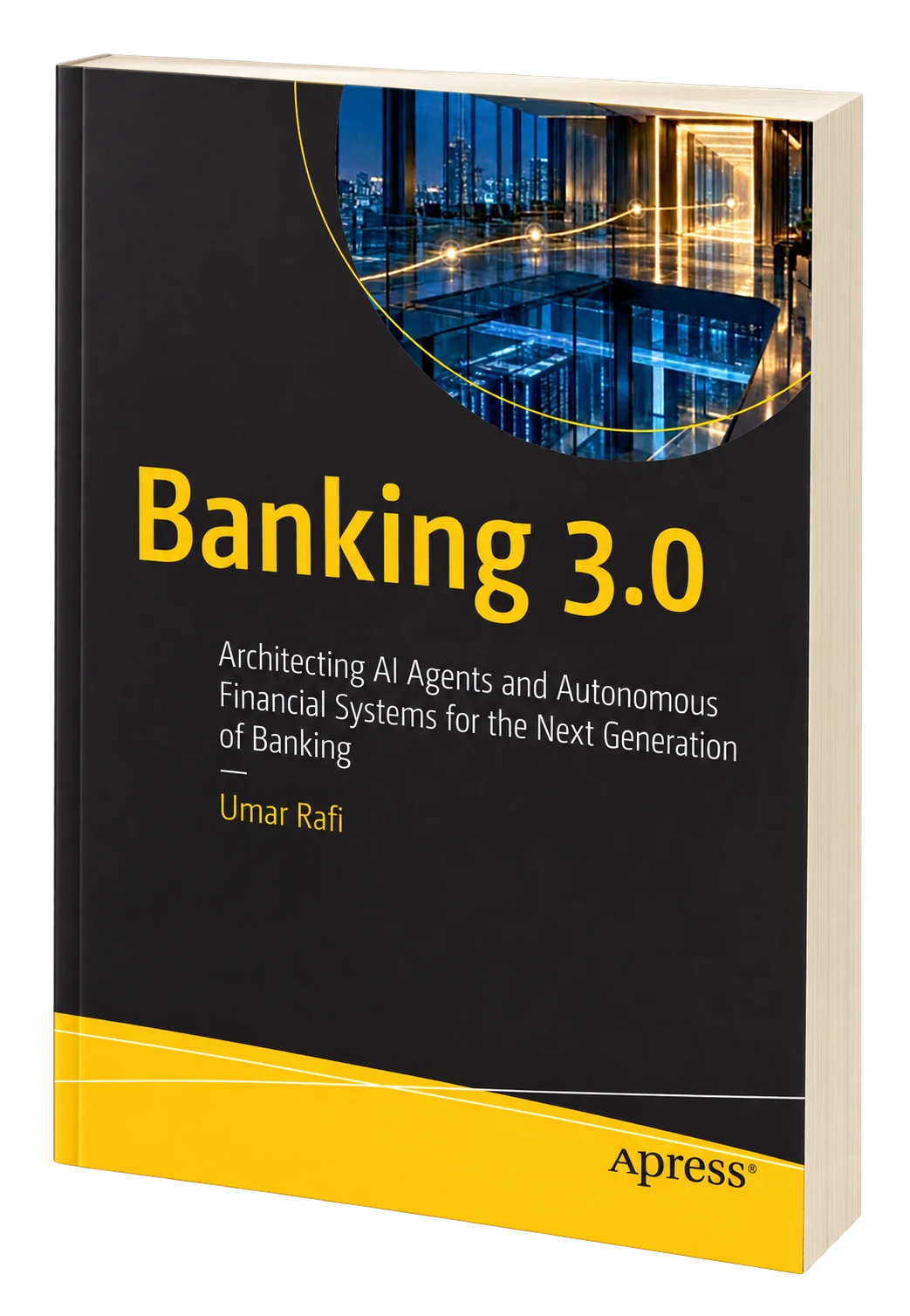
Banking has always been built on trust. For most of its history, that trust lived in people, and in the rules and systems built to remember what happened and to hold it true. Artificial intelligence introduces something different: software that can increasingly interpret, reason, decide, and act.
This book is about the architecture required for that transition. It describes banking through three overlapping eras: Banking 1.0, Banking 2.0, and Banking 3.0. Drawing in part on the author’s twenty-five-year journey through banking and financial-services transformation, it follows the institution from systems that record, to platforms that connect and inform, and finally to agents capable of carrying work.
Commercial products appear where they illuminate an architectural pattern, but the subject is banking architecture itself: the responsibilities that must remain visible as intelligence moves closer to execution.
At the heart of the book is a simple proposition: AI agents inherit the architecture beneath them.
They inherit its data and its gaps, its integrations and its fractures, its permissions and its ambiguities, its resilience, and its weaknesses. An agent does not escape the history of the enterprise simply because it stands at its newest edge.
Agents also inherit the rules that shaped that architecture. Banking regulation has spent decades turning obligations into systems, data requirements, permissions, controls, approval paths, and evidence. As intelligence becomes agency, some governance must move closer to the moment at which the agent reasons and acts. The architecture must establish not only what an agent can do, but what it may do, under what circumstances, on whose authority, and with what evidence left behind.
And the boundary must continue to hold. The bank must know whether the agent remains within it as models, data, tools, policies, and the systems around it change. Governance defines the boundary. Evaluation tests it. Operations must ensure that it endures.
This is not only a book about AI. It is about what must be true before intelligence is allowed to act—and what must remain true after it does.
Systems that record: the institutional memory of the bank, built around transactions, records and the rules that hold them true.
Platforms that connect: data and services brought together to inform decisions and carry work across channels and systems.
Agents that act: intelligence capable of carrying work within explicit boundaries of authority, evidence and accountability.
They inherit its data and its gaps, its integrations and its fractures, its permissions and its ambiguities. An agent does not escape the history of the enterprise simply because it stands at its newest edge.
Defines what an agent may do, under what circumstances, on whose authority, and with what evidence.
Tests whether the agent remains within that boundary as models, data, tools and policies change.
Ensures that the boundary endures as the agent and the surrounding enterprise evolve.