English was the language of my schooling, my training and most of my working life. Its poets came to me as a third inheritance, alongside the Urdu and Punjabi I grew up with. Reading them beside Ghalib and Bulleh Shah, I was struck less by their differences than by how often they asked the same questions: what love demands, what power destroys, and how we live with the knowledge that nothing lasts.
Of all the poets in our mehfil (gathering), only two wrote great poetry in more than one of its languages: Ghalib and Iqbal, in both Urdu and Persian. Iqbal, a gifted polyglot, also had a complete command of Punjabi and English. It is through him that English poetry enters the mehfil most deeply. During his years of study at Cambridge and Munich he immersed himself in Western philosophy and literature, and its ideas run all through his Persian and Urdu verse.
As someone who writes across languages, I find English less yielding to certain kinds of poetry. Urdu and Persian offer me a freedom of phrasing, rhyme and layered meaning that I struggle to reproduce in English. Their ghazals, with recurring rhyme and refrain, and forms such as the qasida (ode) and rubai (quatrain) demand an intricate marriage of thought and sound. English does not readily accommodate these patterns, which remain uncommon in its poetic tradition; reproducing their music can make the language feel strained.
These challenges make me feel that, among the four languages, the English poet faces the hardest task. To my ear, English offers fewer opportunities for rhyme and flexible phrasing to carry a verse. The poet must therefore place greater weight on the idea itself—its originality, precision and emotional force. Where language offers less ready music, the thought must work harder to sing.
Much modern English poetry finds its freedom in what Urdu calls azad shairi, or free verse. Freedom from a fixed pattern, however, does not free a poet from the demands of rhythm, precision and feeling. English has its own disciplines, from the sonnet to the sustained movement of blank verse. In my novel, Asad and Anna debate the relative possibilities of their languages—a conversation shaped by my own attachment to more than one literary world.
For me, English’s particular strength lies in prose. Its global reach has made it a meeting place for writers whose memories, cultures and mother tongues belong elsewhere—almost everyone’s second or third language, and occasionally the one in which we earn our living. Authors across South Asia, Africa and the Caribbean have brought other rhythms and ways of seeing into it. My own novel belongs to that conversation: written in my third language, yet carrying the landscapes and questions of the first two.
English is also the language through which I encountered much of science and much of the world’s translated literature. It has given me access to minds I could not otherwise have met, even as translation reminds me how much a language keeps to itself.
I should confess, though, that my English life has been lived mostly in prose. I have spent my adult years reading English novels, many times more than all the prose I have read in every other language combined. It is prose that drew me to English, and it is in English prose that I now do most of my writing. My acquaintance with English poetry is more limited. Two of these poets I would have chosen in any case: Kipling, because his Lahore is so close to mine, and Shakespeare, well, because he is Shakespeare. The other three I have come to know more slowly, as a reader of novels finding his way into verse. These are the five English poets I return to most.
5. Rudyard Kipling30 December 1865 – 18 January 1936
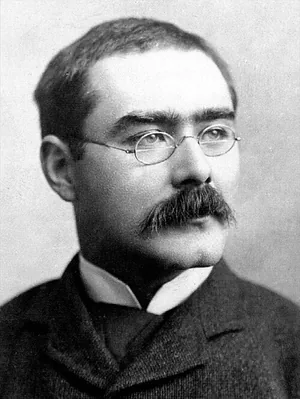
Kipling is the English poet who knew my part of the world. Born in Bombay, he worked as a young man in Lahore and wrote of Punjab, its soldiers and its bazaars with an intimacy that makes his world feel close to mine.
His father, John Lockwood Kipling, ran the Mayo School of Art and the Lahore Museum. After schooling in England, Rudyard returned at sixteen to work on Lahore’s Civil and Military Gazette. He brought the voices of soldiers, sailors and workers into memorable English verse, while The Jungle Book and Kim carried British India into the world’s imagination. He later lived in America before settling in England, where he died in 1936.
His poems include Barrack-Room Ballads, The Ballad of East and West, Recessional and If—, the poem of advice that every young cadet seems to meet sooner or later:
If you can keep your head when all about you
Are losing theirs and blaming it on you…
Lahore travelled with him: he named his Vermont home, where he wrote much of The Jungle Book, Naulakha (“nine lakhs”), after the pavilion in Lahore Fort. The Zamzama, upon which Kim opens, still stands outside the Lahore Museum—a city where monuments preserve one history, while those passing beneath them carry another. Along the same road stood Kipling’s newspaper office, not far from my wife’s family home.
Nearby stands Government College, where Iqbal studied after Kipling had left Lahore, and where Faiz would study a generation later. All three wrote in the same city, yet imagined profoundly different worlds. Kipling was a committed imperialist; Iqbal challenged the submission of peoples to foreign power; Faiz, a committed communist, placed his hopes with workers and the dispossessed.
Kipling’s call to empire finds its starkest expression in The White Man’s Burden:
Take up the White Man’s burden—
Send forth the best ye breed—
Iqbal’s verse points in the opposite direction: towards breaking the chains of the imperialism Kipling defended, challenging the “White Man’s burden” with a people’s right to shape their own destiny.
Ghulami mein na kaam aati hain shamshiren na tadbiren
Jo ho zauq-e-yaqin paida to kat jati hain zanjirenNeither swords nor schemes avail in bondage;
Let conviction awaken, and the chains can break.
Barely two hours from Lahore lies Kasur, where Bulleh Shah had sung his kafis roughly a century and a half before Kipling arrived. The distances are small; the differences in their visions immense. Yet their words belong to the same landscape. Reading them together, I find poetry connecting lives across generations even when their convictions stand on opposing sides.
He is at number five because my admiration for his craft stands alongside my opposition to the imperial attitudes and assumptions of racial superiority that shaped part of his writing. Yet his Lahore remains close to mine. That familiarity gives him a place in my reading without requiring me to share his view of the world.
4. T. S. Eliot26 September 1888 – 4 January 1965
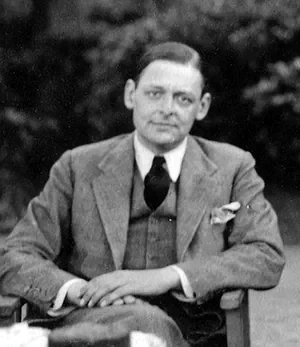
Eliot changed what a poem could be. In the aftermath of the First World War, he wrote poetry that sounded like the modern world: broken, crowded with voices, haunted by the past and searching for meaning.
He was born in St Louis in 1888 and studied philosophy at Harvard, Paris and Oxford. He settled in London, where he worked for eight years in the foreign department of Lloyds Bank, writing poetry in the evenings. He became a British subject in 1927, received the Nobel Prize in 1948, and died in London in 1965.
The bank was not merely a day job. Eliot spent his days tabulating the debts of a broken post-war Europe, and The Waste Land was written out of that office—its fragments shaped by a man who watched a continent’s ruin from a basement desk. He once told his mother the work was “a chaos” of documents.
The Love Song of J. Alfred Prufrock and The Waste Land made his name; Four Quartets, composed from the mid-1930s through the Second World War, is his masterpiece of reflection. Its closing passage, about how all our exploring ends by bringing us back to where we started, to know the place for the first time, could have been written for anyone who has lived in many countries.
His contribution was to make English poetry modern. He wove together quotation, myth and many languages, and ended The Waste Land with words from the Upanishads, drawing East and West into the same poem. He showed that a poem could reflect the fragments of a civilisation and still reach for wholeness. As a critic, he reshaped how a generation read the poets before him.
And the connection runs both ways. Eliot’s own work was profoundly shaped by the philosophy of Hinduism—The Waste Land ends with the Sanskrit prayer Shantih, and Four Quartets draws deeply on the Bhagavad Gita. In turn, his modernist techniques became a model for the new Urdu poetry, especially the poets of the Halqa-e-Arbab-e-Zauq (Circle of the Men of Taste). Poets like Majeed Amjad and Zia Jalandhari used his fragmented style to capture the anxieties of a changing society, and by the 1960s, Pakistani scholars were holding seminars on “Eliot’s Impact on Urdu Literature and Thought.” He was, in a sense, a poet who drew from the East and then gave back to it a new language for the modern world.
He is at number four because, for all his brilliance, he is a poet to be studied as much as felt. His lines about exploration speak closely to my own life across countries. He was born in St Louis, studied in Paris and Oxford, became English in London, and never stopped carrying America within him. He was, like me, a man between worlds—leaving one home, choosing another, and arriving where he started only to know it for the first time.
3. William Wordsworth7 April 1770 – 23 April 1850
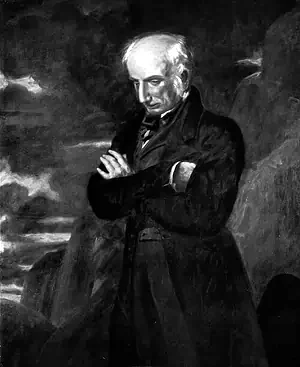
Wordsworth taught English poetry to look at the world with fresh eyes. He believed that nature, memory and the lives of ordinary people were worthy of the highest art, and he helped begin the Romantic movement that changed literature across Europe.
Born in the Lake District in 1770, orphaned young, and educated among the hills and lakes of Hawkshead, he walked across Revolutionary France, returned full of hope and later disappointment, and spent most of his life in the Lakes with his sister Dorothy before becoming Poet Laureate in 1843 and dying at Rydal Mount in 1850.
With Samuel Taylor Coleridge he published Lyrical Ballads in 1798, and the preface to its 1800 edition called poetry “the spontaneous overflow of powerful feelings” that “takes its origin from emotion recollected in tranquillity.” His long autobiographical poem, The Prelude, traces the growth of a poet’s mind. And his daffodils are known to every schoolchild:
For oft, when on my couch I lie
In vacant or in pensive mood,
They flash upon that inward eye
Which is the bliss of solitude.
His contribution was to bring poetry down from formal heights into the language of ordinary life, and to make memory and the natural world its great subjects.
And that vision travelled far beyond England. In Urdu, the reformer Altaf Husain Hali called for a poetry rooted in nature and natural speech, echoing Wordsworth’s “language really used by men”, haunted by his poetics even if he never read him directly. Allama Iqbal’s early nature poetry—odes to the Himalayas, the moon, the glow-worm—carries unmistakable Wordsworthian traces. And in his notebook, Stray Reflections, Iqbal made a confession that binds him to Wordsworth for ever: “Wordsworth saved me from atheism in my student days.”
In Punjabi, his influence arrived through Mohan Singh, who blended Punjabi folk traditions with Western lyrical forms.
There is a complication, though. In his youth, Wordsworth was a republican who praised Toussaint L’Ouverture and the French Revolution. But he grew conservative with age and ended his life a pillar of the establishment of an expanding empire, the same empire that ruled Iqbal’s land. The poet who saved Iqbal from atheism belonged to the empire that ruled him. The connection is real, but it is not innocent.
He is at number three because the two poets above him did something larger still: one gave English its epic, and the other gave it almost everything else.
2. John Milton9 December 1608 – 8 November 1674
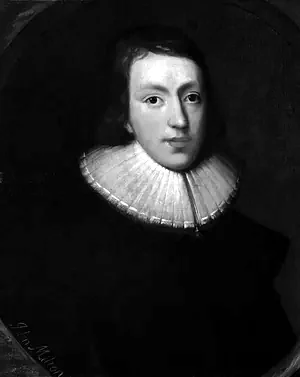
Milton wrote the great epic of the English language, and he wrote it blind. Paradise Lost took on the largest subject imaginable, the fall of humanity, and gave English poetry a grandeur it had never had before.
Born in London in 1608 and educated at Cambridge, he travelled through Italy, met the aged Galileo, and became a fierce pamphleteer for a free press during the English Civil War. He served Cromwell as Secretary for Foreign Tongues, went completely blind by 1652, and after the Restoration dictated Paradise Lost to family and friends before dying in London in 1674.
Paradise Lost, published in 1667, tells the story of Satan’s rebellion and the fall of Adam and Eve, in blank verse of enormous power. It is widely regarded as the first epic of English literature written in the classical style—Milton deliberately positioned himself as the heir of Homer, Virgil, and Dante, seeking to create a work that could stand alongside the Iliad, the Aeneid, and the Divine Comedy. Its most famous character is Satan himself, who speaks some of its most unforgettable lines:
The mind is its own place, and in itself
Can make a Heav’n of Hell, a Hell of Heav’n.
Like Waris Shah’s Heer Ranjha, his epic is a monumental narrative poem that became the quintessential work of its language. Both wrote in poetry—Waris Shah gave Punjabi its qissa (verse romance), Milton gave English its epic. Both took existing traditions, the biblical story of the Fall and the folk legend of Heer and Ranjha, and transformed them into definitive literary achievements that shaped their languages for ever.
And he knew Lahore. In Book XI of Paradise Lost, Milton places the city among the great seats of empire that Adam beholds from the hill of vision:
His eye might there command wherever stood
City of old or modern fame, the seat
Of mightiest empire, from the destined walls
Of Cambalu, seat of Cathaian Can,
And Samarchand by Oxus, Temir’s throne,
To Paquin of Sinaean kings, and thence
To Agra and Lahore of Great Mogul…
He never saw it, never travelled east of Italy, but the reputation of Mughal Lahore had reached him through travellers’ accounts, and he enshrined it in English’s greatest epic. For readers in Pakistan, this is not a small thing: the city we know as a living place was, for Milton, a name worthy of verse. And Lahore is Iqbal’s city—the place where he studied, lived, and is buried. Milton placed Lahore on Adam’s hill of vision; Iqbal gave Lahore its own poetry of the self.
Interestingly, both poets found in Satan a figure worthy of their boldest lines. Milton’s Satan in Paradise Lost is a figure of tragic grandeur—heroic in defiance, eloquent in suffering, yet doomed by his own pride. Iqbal’s Iblis, in poems like Iblees Ki Majlis-e-Shoora (The Devil’s Parliament), is not tragic but necessary—a catalyst for human growth, dignified by his refusal to bow. Milton’s God is a monarch to whom obedience is owed; Iqbal’s God is a teacher who wants humanity to struggle and rise. The same fallen angel, two radically different visions of freedom.
He is at number two because the poet at number one is not only the greatest English poet but, for many, the greatest writer in any language.
1. William ShakespeareBaptised 26 April 1564 – 23 April 1616
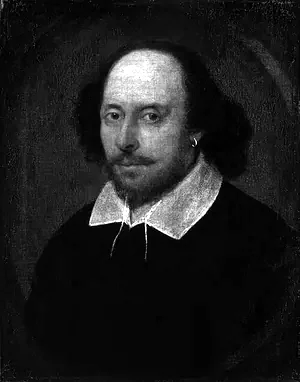
Shakespeare needs no introduction, and that is the measure of him. Four centuries after his death, his plays are performed in every country, his characters are part of how we understand ourselves, and his words are spoken every day by people who have never read him.
After all these languages, all these poets, all these centuries—one name rises above them all. I consider him the best poet of all the poets from the languages we have reviewed, and I say this fully aware of the paradox. He was not, strictly speaking, a poet at all. He was a dramatist. He wrote for the stage, not the page. His lines were born in the mouths of actors, in the light of the Globe, in the roar and whisper of an audience.
The reason he stands above the rest is that he worked with the most rigid set of tools. I know this because I have lived between two linguistic worlds—one where a single word can carry ten meanings and a couplet can hold a universe, and another where the sentence marches forward in a straight line and the rhyme must be earned. Urdu and Farsi are rivers—they bend, they swell, they carry you where they will. Their vocabularies are vast, their rhymes fall like rain, their syntax bends like water around a stone. Punjabi is a river too, wilder and more forgiving. English is a quarry. The words are heavy, the syntax is fixed, the line must be carved, not flowed. While Ghalib worked with water and Waris Shah with wind, Shakespeare worked with stone—and yet he still built a cathedral.
His work ranges from the comedies to the histories to the great tragedies, Hamlet, Othello, King Lear and Macbeth. His poetry lives in three places: over one hundred and fifty sonnets; the long narrative poems like Venus and Adonis and The Rape of Lucrece; and—most abundantly—inside the plays themselves, where blank verse carries the action and over a hundred songs and sonnets bloom within the dialogue.
Part of his fame as hands-down the most globally known and read writer of any language is due to the colonial dominance of English—but the fact that no other English writer has dominated like that, with or without colonialism, is because his writing speaks to something universal in the human heart, something that survives translation and time.
His poetry moves through bodies, through exits and entrances—one of his best-known speeches could almost be a translation of Ghalib:
All the world’s a stage,
And all the men and women merely players;
They have their exits and their entrances…
His plays travelled to South Asia early, and the Urdu stage adaptations alone are a testament to his reach: Cymbeline became Sone Ke Mul Ki Khurshid (The Sun of the Golden Land)—the first Urdu adaptation, in 1871—Hamlet became Khun-e-Nahaq (The Unjust Blood), King Lear became Safed Khoon (White Blood), Othello became Sher-Dil (Lion-Hearted), and The Merchant of Venice alone had multiple versions, including Dil Fareib (The Heart-Deceiver) and Chand Shah-Seudagar (The Moon and the Merchant). The list goes on—too long to enumerate fully. They were a part of my English literature classes in Pakistan in high school and in college, where our English professor could quote Shakespeare ad nauseam from memory despite having never been to the UK. And so our journey through the languages and the poets who shaped them ends where it should.
However, before we depart, let me take the liberty of a personal conclusion. If we set aside the many causes the poets in this series asked their verse to serve—the enforcement of empire and the resistance to it, the call to revolution and the philosophy of the self, the mystic’s longing for God and the moralist’s counsel, the defiance of the clergy and the preservation of a nation’s memory, the grief of a partitioned land and a woman’s claim to her own desire—and judge only the mastery of the written word itself, I cannot think of anyone who stands above my two favourites: the Bard of English and the Grand Old Man of Urdu. One was the master of the theatre, the other the master of the couplet. Ghalib saw the world as a playground; Shakespeare saw it as a stage. Between them, I think, they said most of what there is to say.
Standing between these two giants, I can do no better than borrow from the first to praise the second, and, with the audacity of the uninvited, squeeze myself into the conversation:
تحریر کے تم ہی استاد نہیں ہو عمرکہتے ہیں ولایت میں اک شیکسپیئر بھی تو تھا
Tahrīr ke tum hī ustād nahīñ ho UmarKahte haiñ Vilāyat meñ ik Shakespeare bhī to thā